Japanese stab binding and Coptic binding are two of the most widely taught traditional bookbinding methods in Canadian craft studios and continuing education programmes. Both have structural characteristics that make them suitable for specific uses — and limitations that define where they work less well. This overview covers the structural logic, materials, and step-by-step approach to each technique as commonly practised in Canadian workshops.
Neither technique is particularly difficult to learn at a basic level, but both reward practice in terms of consistent hole spacing, thread tension, and the cleanliness of sewing patterns. The notes below describe the standard approach taught in Canadian studio contexts, with notes on variations that experienced binders use.
Japanese stab binding: structure and context
Japanese stab binding (fukurotoji in Japanese, meaning "pouch binding") binds a stack of pages by passing thread through a series of holes pierced along the spine edge of the book. The thread is sewn in a pattern — the exact pattern varies by tradition — and the stitching remains visible on the outside cover of the book as a decorative element.
The structure does not use sewn signatures. Pages are either single sheets or sheets folded in half with the fold facing outward (the "pouch" of fukurotoji, which protects the uncut inner edge). The binding holds the text block together purely through the stitching at the spine edge.
Structural considerations
Because the binding passes through the text block laterally, the book does not open flat — pages are held under tension from the stitching. This makes Japanese stab binding unsuitable for books that need to open completely flat, such as sketchbooks or music scores. It is well-suited to:
- Notebooks used for writing or drawing at an angle (not requiring a fully flat-open page)
- Short book structures (typically 50–120 pages) where the sewing tension is manageable
- Decorative or artist books where the visible stitching is part of the aesthetic intent
- Sample books, reference volumes, and limited-edition printed works where structural elegance matters more than flat-opening functionality
Materials
A standard stab-bound book requires: a folded or stacked text block, two cover boards (or a soft cover in the same paper as the text), a sewing needle, thread (waxed linen or silk thread are standard — waxed linen for durability, silk for fine decorative work), a bone folder, a bookbinding awl or drill for piercing holes, and a metal ruler and pencil for marking hole positions.
Thread choice affects both the visual result and the durability of the binding. Waxed linen thread in 18/3 or 25/3 weight is used in most Canadian workshop contexts. The waxing reduces tangling and fraying and makes the thread slightly stiffer, which helps control the sewing pattern. Silk thread produces a finer, more lustrous stitch but is less durable over time — it is occasionally used for fine edition books in Canadian studios but less often in workshop instruction.
Hole spacing and positioning
Holes are typically placed 5–8 mm from the spine edge of the text block. The number and spacing of holes varies by pattern:
- Four-hole binding (yotsume-toji): The simplest pattern. Four holes, evenly spaced, with end holes placed approximately 12–15 mm from the head and tail of the book. The thread makes a simple running stitch along the spine, wrapping around the head and tail to secure the ends.
- Hemp leaf binding (asa-no-ha-toji): A more complex pattern using 10 or more holes to create a radiating, lattice-like pattern visible on the spine. This pattern requires careful planning of hole positions and thread routes before starting.
- Tortoise shell binding (kikko-toji): A hexagonal repeating pattern. Requires an odd number of holes (typically 7 or more) and careful tension management to keep the geometric shape consistent.
For workshop instruction in Canada, the four-hole binding is almost universally taught first, as it establishes the basic principles of hole spacing, thread management, and end-knot placement before introducing more complex patterns.
Step-by-step: four-hole stab binding
- Collate and jog the text block square. Clamp or hold firmly while marking hole positions along the spine edge.
- Pierce holes through the entire text block and covers using an awl or bookbinding drill. On thicker books, it is easier to pierce the covers separately and clamp the covers to the text block for final sewing.
- Cut a thread length approximately three times the height of the book plus the depth of the spine.
- Beginning at the second hole from the head, pass the needle through from front to back, leaving a tail of approximately 8 cm on the front cover.
- Wrap around the head of the book and pass through hole 1 from front to back, then back through hole 1 from back to front.
- Pass down to hole 2 from front to back, then to hole 3, then hole 4, wrapping around the tail of the book as at the head.
- Return up to hole 3, then hole 2, then hole 1. Tie off at hole 2 by passing the needle under the crossing thread and knotting with the starting tail.
Coptic binding: structure and context
Coptic binding is named after the Coptic Christians of Egypt, whose earliest surviving codices (bound manuscripts) from the 4th and 5th centuries CE used a chain-stitch sewing structure that links multiple sewn signatures together without adhesive and without covering the spine. The defining characteristic of a Coptic-bound book is the open, exposed spine through which the chain-stitch linking can be seen — and the fact that the book opens completely flat at any page.

Structural characteristics
Coptic binding uses signatures — typically 4–8 folded sheets per signature — sewn together through a kettle stitch (a chain stitch that links each signature to the previous one). Because the sewing itself holds the signatures together and holds the covers, no spine lining or adhesive is required at the spine. The book is flexible, opens flat, and the spine remains completely visible as a structural and decorative element.
The exposed spine means Coptic binding is not suitable for books that will see heavy use in conditions where the spine structure could be pulled or snagged, or for books that need to be shelved spine-out in a library context (the exposed sewing is visible but not labellable). It is widely used for:
- Sketchbooks and artists' journals, where flat-opening functionality is essential
- Fine edition books and handmade books where the structural craft is part of the visual language
- Refillable notebook structures (the covers can be reused by resewing new signatures)
Materials
Coptic binding requires: folded and pressed signatures, two cover boards (traditionally wooden boards, as in historical Coptic manuscripts, though binder's board and decorative paper-covered boards are more common in contemporary practice), sewing needle, waxed linen thread (18/3 weight for most applications), bone folder, bookbinding awl, ruler, pencil, and a sewing frame or clamp for holding signatures during sewing.
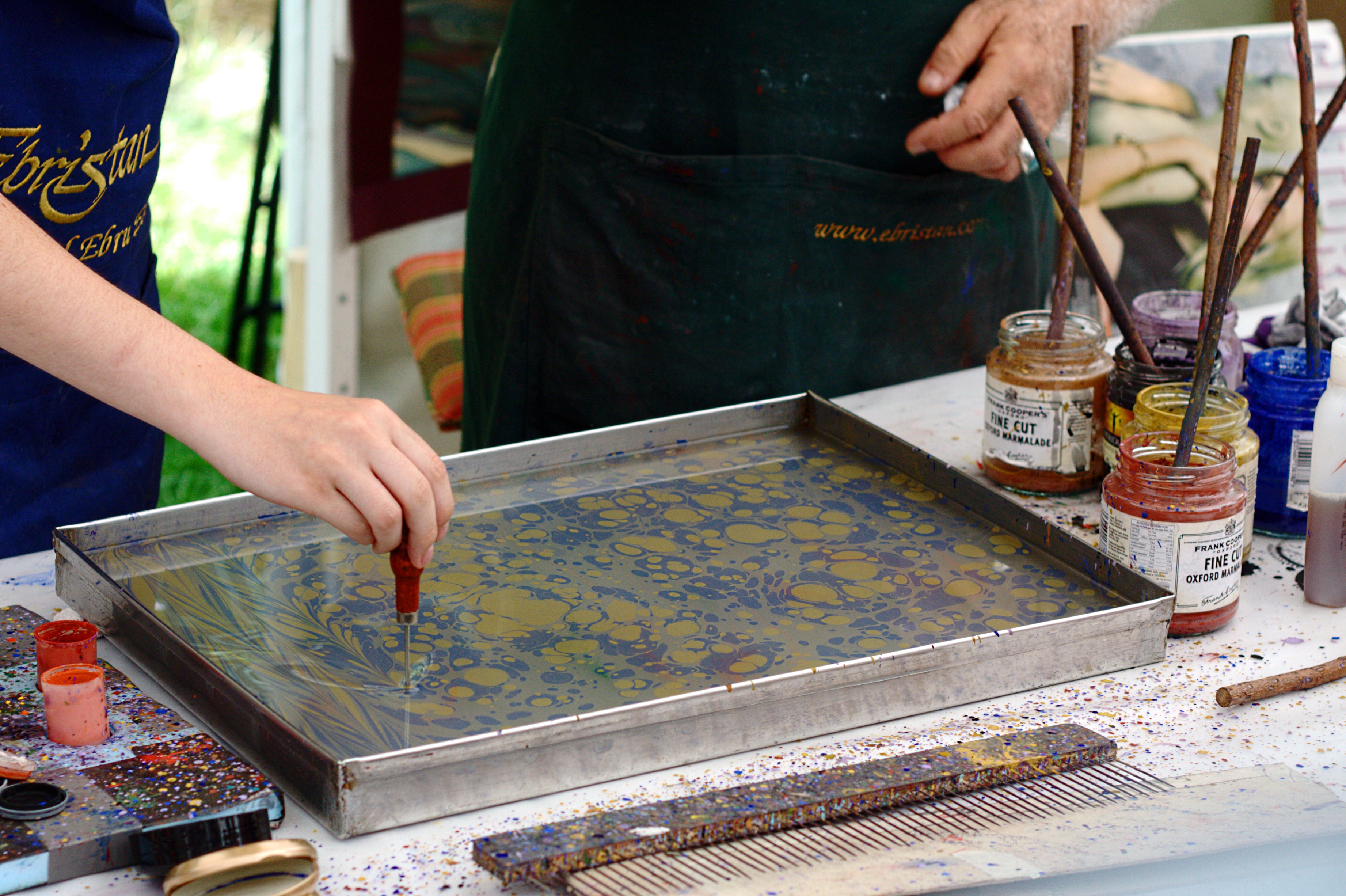
Cover boards in Canadian studio practice are typically binder's board (high-density compressed board) covered with book cloth, Japanese tissue-backed decorative paper, or marbled paper — making Coptic binding a natural pairing with paper marbling. A marbled paper cover on a Coptic-bound sketchbook is a combination frequently produced in CBBAG workshops across Canada.
Piercing signatures for Coptic sewing
Holes are pierced along the fold of each signature and in corresponding positions through the cover boards. Consistent hole spacing is critical — variation in hole position causes the chain-stitch to pull unevenly, distorting the spine pattern. Hole spacing of 12–20 mm is standard, with end holes (the kettle stitch positions) placed 8–10 mm from the head and tail.
Signatures are pierced while held closed using a bookbinding awl through a paper template. Using a consistent template for all signatures and the covers is the most reliable way to achieve even spacing. In Canadian workshops, a template cut from scrap board or card stock is distributed to students to use for their own books.
The kettle stitch
The kettle stitch (from the German Kettenstich, meaning "chain stitch") is the linking stitch between signatures. After sewing through the last hole in a new signature, the needle passes under the linking thread of the previous signature before re-entering the new signature to begin the return pass. This creates the chain link visible at each sewing station on the spine.
Consistent thread tension is the main challenge in learning Coptic sewing. Too loose and the signatures slide against each other, creating gaps in the spine; too tight and the pages buckle within each signature. Most Canadian workshop instructors describe a tension that is "firm but not taut" — the thread should not stretch the signature folds when pulled.
Step-by-step: basic Coptic sewing (simplified)
- Pierce all signatures and covers using a consistent template. Mark head and tail holes clearly.
- Sew the first signature to the front cover: begin at the tail kettle stitch hole, pass through the signature and cover, and sew a running stitch to the head, ending with a half-hitch knot around the last stitch.
- Begin the second signature at the head: pass through the signature's head hole, then loop under the previous signature's head kettle stitch before re-entering the same hole from outside to lock the link.
- Sew down the second signature with a running stitch to the tail, linking at the tail kettle stitch as at the head.
- Continue adding signatures in the same way, linking at each kettle stitch position.
- Attach the back cover in the same way as the front cover was attached in step 2. Tie off the thread inside the last signature with a double half-hitch knot.
Canadian teaching contexts and resources
Both Japanese stab binding and Coptic binding are regularly taught in continuing education programmes at Canadian colleges and universities, and through CBBAG chapter events. Workshops of one to two days' duration are the standard format for introductory stab binding instruction; Coptic binding typically requires a longer session (two to three days in studio programmes) due to the greater number of steps and the importance of practising consistent tension.
The Canadian Bookbinders and Book Artists Guild publishes a newsletter that lists upcoming workshops, and its chapters in Toronto, Vancouver, Ottawa, and Montreal hold periodic open studio events where these techniques can be observed and practised under guidance. The Guild also maintains a directory of members who offer individual instruction.
Reference texts commonly used in Canadian studio teaching include Keith Smith's Non-Adhesive Binding series (which covers both stab and Coptic structures in detail) and Esther K. Smith's How to Make Books. Both are available through Canadian library systems and are regularly referenced in CBBAG workshop materials.