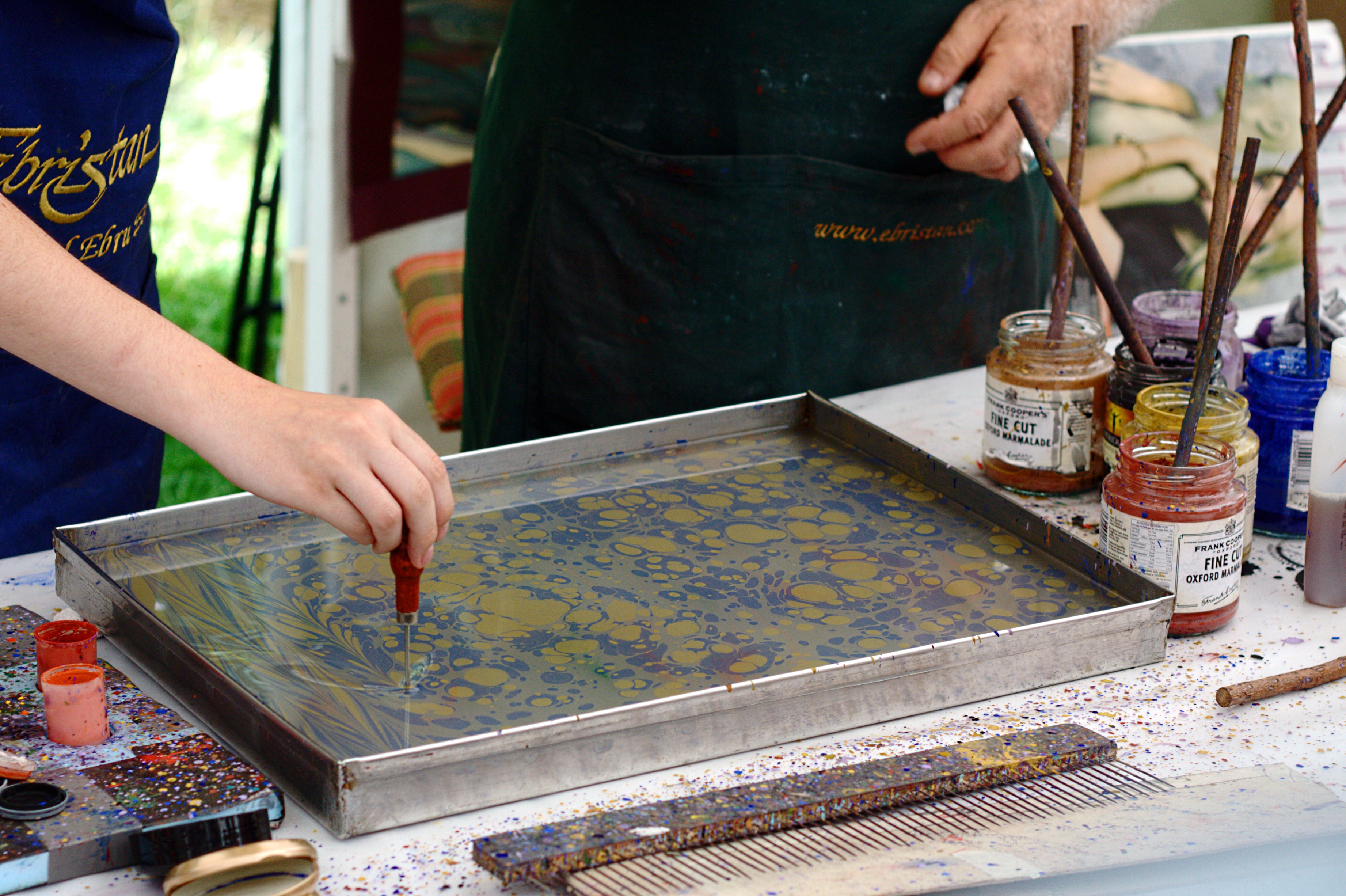
Paper marbling is one of the oldest decorative paper arts still practised in its traditional form. The technique involves floating paints or inks on a thickened water surface, manipulating them into patterns, and transferring those patterns to paper or fabric. In Canada, marbling appears most commonly as endpaper work in hand-bound books, as standalone decorative prints, and increasingly as a medium in its own right among studio artists in British Columbia, Ontario, and Quebec.
This overview covers the core technical elements of marbling as practised in Canadian studios: size preparation, paint preparation, paper preparation, pattern-making, and the regional variables — particularly water chemistry — that affect results in ways suppliers and general tutorials rarely address.
The marbling size: carrageenan and its regional variables
The "size" — the thickened water that supports paint during marbling — is the most critical variable in the process. The standard medium used in contemporary marbling studios is carrageenan, a polysaccharide derived from red algae, particularly Chondrus crispus (Irish moss) and related species.
Carrageenan is available in two forms relevant to marbling: lambda carrageenan, which remains viscous regardless of temperature and does not gel, and kappa carrageenan, which forms a firm gel when cooled. Lambda carrageenan is the standard for marbling. It is sold as a powder and hydrates in cold water, typically over 12–24 hours.
Standard preparation
A working starting point for most Canadian tap water in moderate hardness ranges (100–200 mg/L as CaCO₃) is approximately 2 tablespoons of lambda carrageenan powder per US gallon of cold water. This is blended or whisked into the water and left to hydrate, ideally overnight, before removing surface foam and testing consistency.
Correct size consistency allows a single drop of paint to spread slowly — not instantly pooling to the tank edges, but not sitting as a hard bead either. A drop should spread to roughly 15–25 cm in a standard marbling tray before slowing and stabilizing.
Water hardness adjustments by Canadian region
Canadian municipal water hardness varies considerably, and this affects size behaviour in ways that are rarely discussed in general marbling guides written for American or European audiences:
- Vancouver and Victoria (BC coastal): Exceptionally soft water — often below 20 mg/L CaCO₃. Soft water produces a size that allows paint to spread very freely, sometimes too freely. Practitioners in Vancouver studios typically use a slightly higher carrageenan concentration (closer to 2.5 tablespoons per gallon) and may add a small amount of alum to the size to increase surface tension.
- Calgary and Edmonton: Hard to very hard water, ranging from 180–250 mg/L CaCO₃. Hard water can cause carrageenan to hydrate unevenly and can make paints reluctant to spread. Many Calgary marbling practitioners use bottled or filtered water for their size, or treat tap water with a small amount of oxalic acid to reduce carbonate hardness before mixing carrageenan.
- Toronto: Moderate hardness, typically 120–140 mg/L. Standard preparation works reliably. The standard 2 tablespoons per gallon ratio is well-suited to Toronto tap water and produces consistent results with most watercolour and acrylic marbling paints.
- Montreal: Soft to moderate — generally 40–80 mg/L. Behaviour is closer to Vancouver than Toronto. Montreal studio practitioners tend to use slightly more concentrated size and apply ox gall sparingly.
Paint preparation and ox gall
The paints used in marbling must be able to float on the size without sinking. Two main types are used in Canadian studios:
Watercolour and gouache-based paints
Traditional Turkish (Ebru) marbling uses watercolour pigments ground in ox gall — the bile of cattle — which acts as a surfactant, reducing surface tension and allowing the paint to spread on the carrageenan size. Canadian practitioners can source ox gall solution from bookbinding and conservation suppliers. The standard ratio is approximately 5–10 drops of ox gall solution per teaspoon of liquid watercolour paint, adjusted by observation.
Ox gall is a variable substance — its effectiveness differs between batches and suppliers. A useful test is to drop a small amount of prepared paint onto the size surface: it should spread to a thin, even film with clear edges. If the paint sinks or beads without spreading, more ox gall is needed. If it spreads instantly to the tank edges, the ox gall ratio is too high.
Acrylic-based marbling paints
Several commercial marbling paint lines formulated for carrageenan marbling are available in Canada, including products distributed through craft supply chains. These paints have surfactants pre-mixed and do not require additional ox gall. Their spreading behaviour is more consistent than hand-mixed watercolour paints, which makes them useful for learners, but experienced practitioners often find they produce less nuanced colour and less defined pattern edges than ox-gall watercolours.
Paper preparation: alum sizing
Untreated paper absorbs moisture during the marbling process but does not accept pigment permanently — the colour washes off when the paper is rinsed. To fix the paint to the paper, the sheet must be treated with an alum solution before marbling.
The standard preparation is a solution of potassium alum (aluminium potassium sulphate) — approximately 30 grams per litre of warm water — applied by sponge or brush to the surface of the paper that will contact the size. The paper is then hung to dry completely before use. Paper treated in this way can be stored for weeks before marbling.
Alum concentration matters. Too little alum and the print will wash off; too much and the paper becomes brittle after marbling, particularly noticeable with thinner printing papers. For the lightweight uncoated papers favoured for endpaper work — typically 60–80 gsm — a 3% alum solution applied in a single even coat is generally sufficient.
Pattern types in traditional marbling
The vocabulary of marbling patterns has been largely stable since the technique spread through Europe in the 16th and 17th centuries via Ottoman trade routes. A small number of foundational pattern types are produced through specific sequences of tool movements across the floating paint surface:
Stone (or nonpareil base)
The simplest pattern — drops of paint applied to the size surface and left undisturbed, or given minimal spreading. Produces a spotted or pebble-like appearance. Often used as a base layer before further manipulation.
Gel git (Italian vein or Spanish wave)
A comb with closely spaced tines (typically 1–2 cm apart) is drawn across the surface in one direction, then the tank is tilted back and forth to create wave-like curves. This produces the characteristic flowing pattern seen on marbled book covers from the 18th and 19th centuries.
Combed nonpareil
Produces a fine herringbone or feather pattern. A wide-tined comb (tines spaced 3–5 cm) is drawn in one direction; a fine-tined comb (tines 1 cm apart, offset to pass between the first comb's tines) is drawn in the perpendicular direction. The result is a dense grid of interlocking curves that, when further manipulated, produces the characteristic "peacock feather" or "bouquet" patterns seen in period bookbinding.
Freestyle / stylus drawing
A fine-pointed stylus or skewer is drawn through the paint surface to create free-form designs — flowers, feathers, or abstract curves. This technique requires a stable, well-prepared size; patterns drawn in an over-thinned size will blur.
Historical context in Canadian bookbinding
Marbled paper arrived in Canada via European bookbinding traditions. Books bound for the early colonial administration in Quebec and Ontario frequently featured imported marbled endpapers — primarily from Germany, France, and the Netherlands, which were the dominant producers of marbled paper in the 17th through 19th centuries.
Domestic Canadian marbling developed slowly through the 20th century, primarily within the fine binding community. The Canadian Bookbinders and Book Artists Guild (CBBAG), founded in 1983, has been the most significant institution for documenting and transmitting traditional paper arts including marbling. CBBAG chapters in Toronto, Vancouver, and Montreal have run marbling workshops intermittently since the 1980s.
Contemporary Canadian marbling practitioners largely learned through workshop circuits, individual mentorship, or self-directed study from reference texts. The most widely used historical reference in Canadian studios is The Art and Craft of Marbling by Gabriele Grünebaum, though practitioners frequently note that its carrageenan instructions require adjustment for North American water chemistry.
Common problems and causes
- Paint sinking: Most often a surfactant problem — insufficient ox gall, or paint mixed too thickly. Also occurs when size temperature is too low (below 18°C).
- Paint spreading to tank edges immediately: Excess ox gall, size too thin, or size contaminated with soap residue from inadequate cleaning.
- Print washes off during rinsing: Alum concentration too low, or paper alum treatment was applied unevenly.
- Colours bleed into each other during combing: Size too thin, or the interval between applying paint and combing was too long (allowing surface tension to equalize). Painting and combing should be done in relatively quick succession.
- Carrageenan not hydrating smoothly: Water too hard, or powder not blended into cold water before hydrating. Adding carrageenan to warm water causes it to clump. Always blend into cold water, then leave to hydrate at room temperature.
For current material sourcing within Canada, the Library and Archives Canada conservation resources page and CBBAG's member newsletter carry periodic updates on Canadian suppliers for conservation-grade carrageenan, alum, and ox gall.

